
Ramsar Sites in India 2026: Complete List of All 101 Wetlands
Explore every Ramsar site in India, first in chronological order of designation and then state-wise, with area, key facts and exam-ready records.
What are Ramsar sites in India?
Ramsar sites in India are wetlands recognised as internationally important under the Ramsar Convention, adopted on 2 February 1971 at Ramsar, Iran, in force since 1975. India joined in 1982. The Convention rests on the principle of “wise use”: using wetlands sustainably without harming their ecological character.
India’s list of Ramsar sites grew from 26 in 2014 to 101 in August 2026, when Glaw Lake in Arunachal Pradesh became the 101st. These Ramsar wetlands include lakes, rivers, mangroves, marshes, reservoirs and coastal lagoons. They shelter migratory birds, control floods, recharge groundwater and support fishing and farming. Tamil Nadu (20) and Uttar Pradesh (13) lead the state-wise list of Ramsar sites.
Ramsar sites in India: FAQs
How many total Ramsar sites are there in India?
101 as of August 2026. The official list stood at 99 in April 2026, then Surha Tal (100th) and Glaw Lake (101st) were added.
Which is the largest Ramsar site in India?
Sundarban Wetland, West Bengal: about 4,23,000 hectares (4,230 km²). Next are Vembanad-Kol (1,51,250 ha) and Chilika (1,16,500 ha).
Which is the smallest Ramsar site?
Renuka Wetland (Himachal Pradesh) and Vembannur Wetland Complex (Tamil Nadu), each about 20 hectares.
Which were the first Ramsar sites in India?
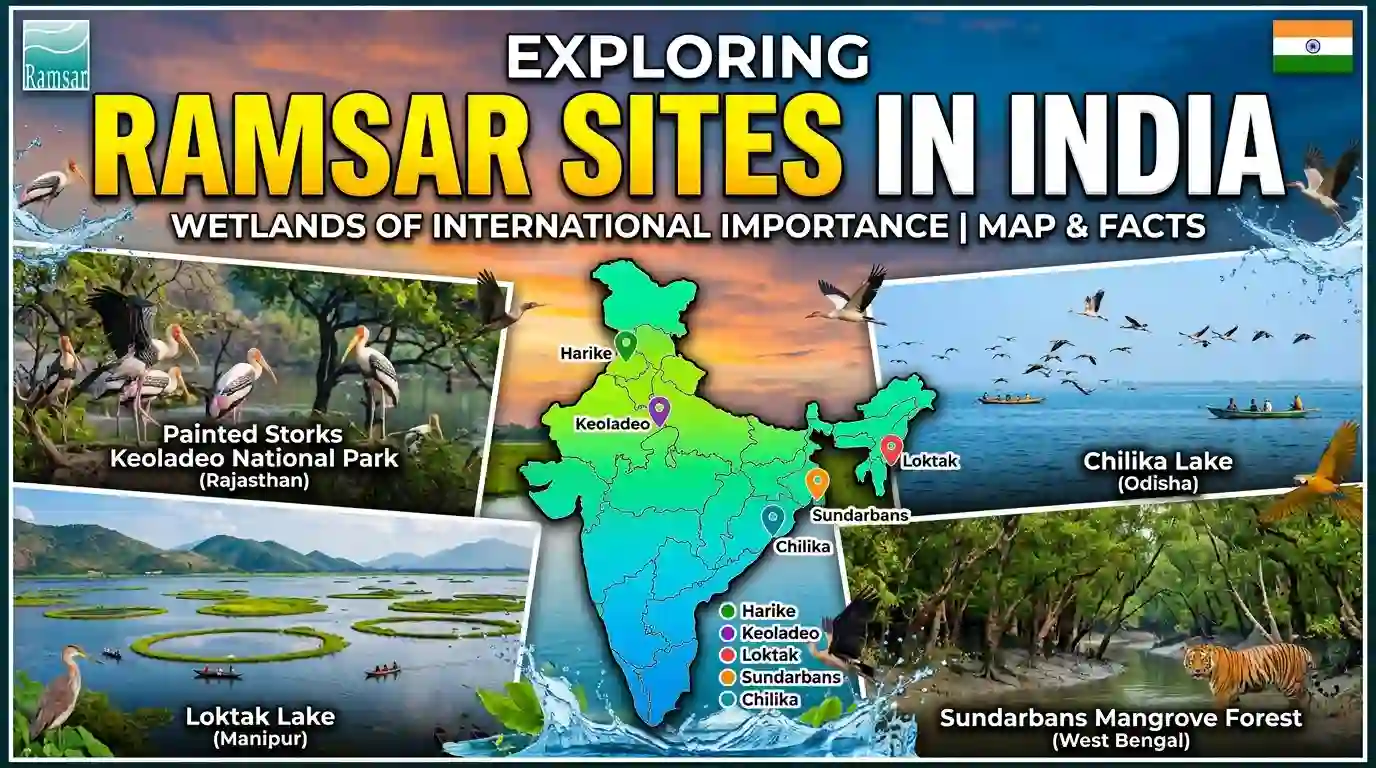
Chilika Lake (Odisha) and Keoladeo National Park (Rajasthan), both designated on 1 October 1981.
Which Ramsar sites are on the Montreux Record?
Keoladeo National Park (1990) and Loktak Lake (1993). The record lists sites facing ecological change.
How many Ramsar sites are in Jammu & Kashmir and Ladakh?
J&K has 5 (Wular, Hokera, Surinsar-Mansar, Hygam, Shallbugh) and Ladakh has 2 (Tso Kar, Tsomoriri).